Open roles need attention from people who might do the work. A careers page cannot create that attention by itself, especially when an employer is competing with job boards and other organizations for candidates.
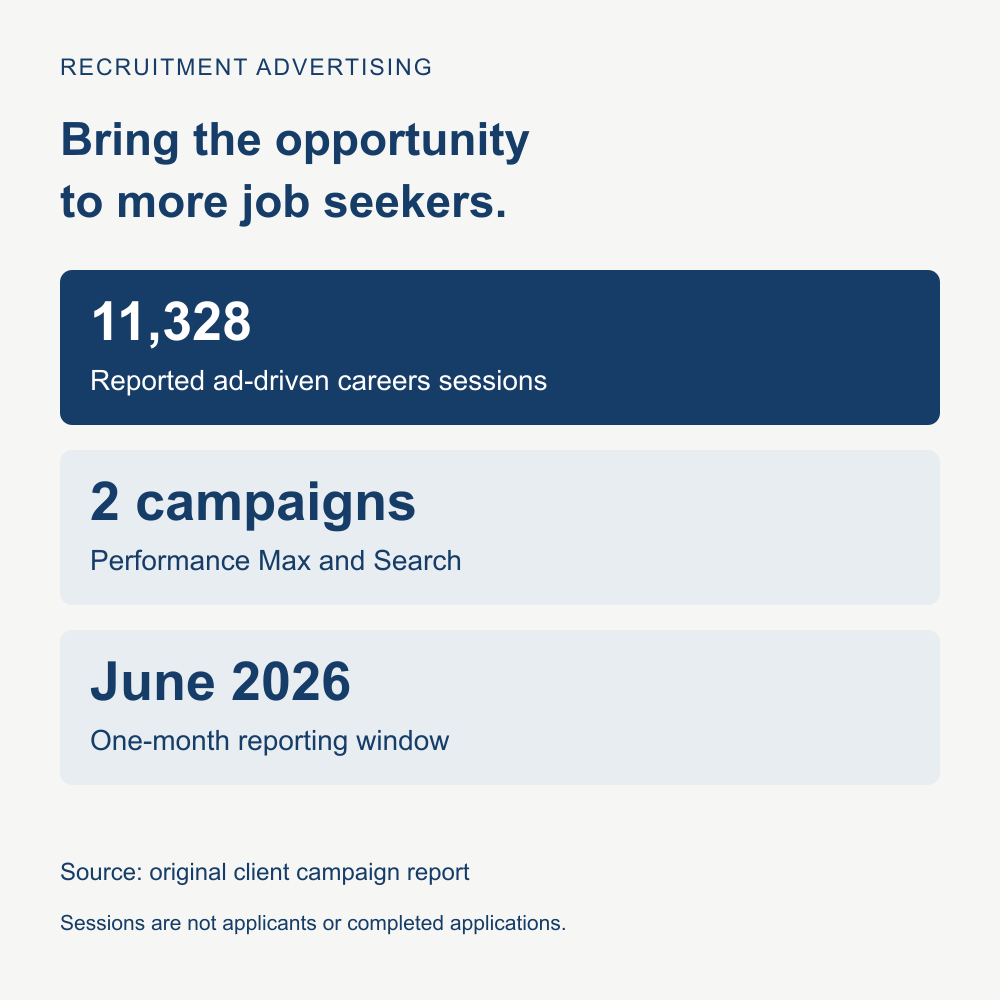
For this employer, two focused recruitment campaigns delivered 11,328 reported sessions to its careers page in June 2026. The program put job opportunities in front of a substantially larger audience than the careers page was receiving through organic search alone.
Make the opportunity easier to discover
The advertising focused on two priority role categories: direct-support and teaching-assistant positions. Performance Max and Search campaigns directed people to the careers page, where they could explore available opportunities.
This gave the employer an active route to potential candidates instead of relying solely on people who already knew the organization or happened to find its website.
More than 11,000 campaign-driven careers sessions
The original June report attributed 10,337 sessions to the main recruitment campaign and 991 to the search campaign, totaling 11,328. Organic search contributed 192 sessions in that report.
The commercially useful result is the scale of attention directed to the employer’s opportunities. Those sessions represent visits, not 11,328 different people and not 11,328 submitted applications.
Connect the advertisement to the role
The campaign’s role focus mattered. Recruitment advertising needs to communicate an opportunity clearly enough for someone to decide whether to explore it. Sending that person to the careers destination connects the message to available jobs rather than leaving the next step implicit.
The work also included tracking and reporting across the careers page and a third-party application system. Correspondence documents efforts to identify job-level activity and completed applications, rather than judging the program only by advertisement clicks.
Build the candidate journey, then measure the next step
Traffic to a careers page is the beginning of a recruitment result. The next questions concern which roles attract interest, where applicants drop out and which sources produce completed applications.
The records reviewed for this case support the careers-session total. They do not establish an attributable completed-application or hiring total, so those outcomes are not substituted for visits.
Are the right people seeing your open roles?
A recruitment campaign should start with the positions you need to fill and give potential candidates a clear reason to explore them. We connect digital advertising, relevant creative and the application journey around that objective.
Let’s discuss the roles you need to fill and how to bring more relevant attention to them.
Source: original June 1–30, 2026 recruitment campaign report; campaign and tracking scope corroborated by July 2026 correspondence. Sessions are report-attributed visits, not applicants. Employer identity is confidential.