The 90-Day Marketing Plan for a Cape Cod Business Heading Into the Off-Season
A 90-day marketing plan for a Cape Cod business should do three things: turn summer lessons into evidence, choose one off-season offer for a defined audience, and connect content, local search, follow-up, and measurement around that offer. The goal is not to stay noisy after Labor Day. It is to build steadier demand and a better operating system.
Cape Cod does not move from “busy” to “closed” in one weekend. The Cape Cod Chamber describes fall as a “Second Summer,” while the broader shoulder season stretches from September into early June. The opportunity is real, but the audience, pace, staffing, and buying triggers change. A useful plan responds to those changes instead of extending a summer campaign with different photos.
Why the next 90 days matter
Tourism remains central to the regional economy. The Cape Cod Chamber reports that Cape Cod generated $2.776 billion in direct visitor spending in 2024 and that visitors accounted for 47% of local-business spending between April and September. That seasonal concentration creates a predictable marketing problem: businesses often reach Labor Day with new customer data, creative assets, reviews, and unanswered questions, but no system for carrying that value into fall and winter.
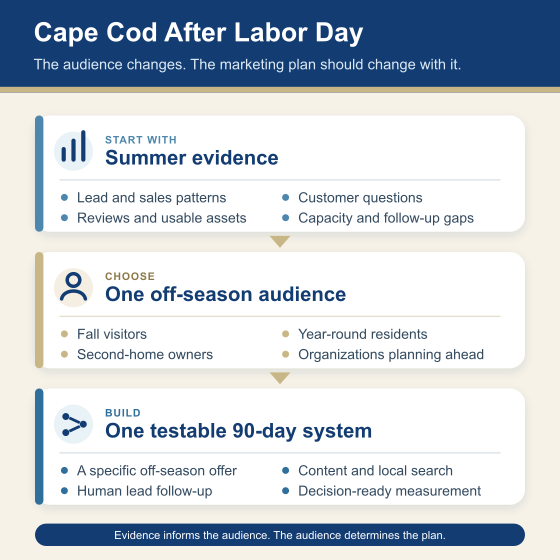
At the same time, Cape Cod is not one audience. Year-round residents, second-home owners, fall visitors, seasonal homeowners planning maintenance, and organizations building next year’s budgets move on different timelines. Your plan should decide which of those groups matters most for the next quarter and what action you can realistically support.
The 90-day plan at a glance
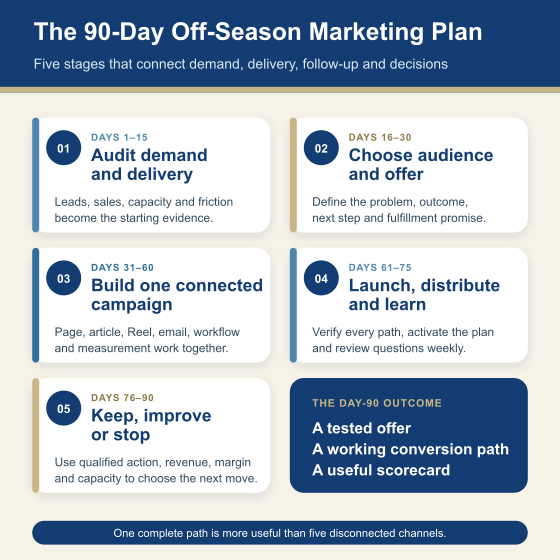
Days 1–15: Audit demand and delivery. What did summer reveal about demand, capacity, and customer friction?
Days 16–30: Choose one audience and offer. What can we sell profitably and fulfill well this quarter?
Days 31–60: Build the campaign and follow-up system. Can a prospect move from discovery to a timely human response without getting lost?
Days 61–75: Launch, distribute, and learn. Which message and channel are producing qualified action?
Days 76–90: Keep, cut, or scale. What deserves another quarter of time and budget?
Days 1–15: turn the summer rush into evidence
Start with the business, not the content calendar. Pull the facts your team can actually verify:
Leads and sales by source, service, location, and customer type
Top-selling and highest-margin offers
Missed calls, abandoned forms, slow replies, and unworked inquiries
Capacity constraints, fulfillment problems, and work the team should not pursue
Customer questions that appeared repeatedly in calls, reviews, email, and social messages
Photos, testimonials, project details, and lessons you have permission to use
Then separate the audience. A visitor deciding where to eat tonight is not on the same journey as a second-home owner planning winterization, a resident comparing year-round professional services, or a business owner setting a 2027 budget. Your highest-volume summer audience may not be the best off-season audience.
Use this first phase to fix obvious trust leaks, too. Make sure website hours, contact details, forms, menus, service availability, and Google Business Profile information agree. Google’s current Business Profile guidance allows businesses to use seasonal hours as regular hours while open, set special hours for holidays or temporary changes, and mark a truly seasonal operation temporarily closed during the off-season. Accuracy is part of marketing because it determines whether a customer can act on what they find.
Days 16–30: choose one offer the operation can support
Do not build a 90-day campaign around “stay top of mind.” Choose one business outcome. Examples include:
Hospitality or retail: a fall experience, holiday package, gift program, or resident-focused reason to return
Home services: a maintenance, inspection, planning, or early-booking offer tied to a real seasonal need
Professional services: a year-end review, planning session, audit, or fixed-scope assessment
Construction or design: a planning-stage consultation that matches the long lead time before permits, design, and production
Nonprofits and associations: a donor, membership, volunteer, or event action with one measurable next step
The offer needs five parts: a defined audience, a specific problem, a useful outcome, a clear next step, and a fulfillment promise your team can keep. A discount is optional. Clarity is not.
Write the positioning in one sentence: For [audience] who need [outcome], we provide [offer] so they can [business or life result], with [proof or differentiator]. If that sentence is vague, the website, Reel, email, and sales follow-up will be vague, too.
Days 31–60: build one connected campaign
Now create the minimum useful system around the offer:
One destination page. Give the offer a page with a direct answer, who it is for, what is included, proof, practical details, FAQs, and one primary call to action.
One authority article. Answer the larger question that sends the right reader to the offer. Use first-hand experience, local context, examples, and sources rather than generic advice.
One Reel. Tease the problem and the first useful step. Send people through LinkTree to the article instead of trying to fit the entire lesson into the caption.
One email sequence. Start with the article, follow with proof or an example, then make the offer. Existing customers and opted-in leads should not receive the same message as cold prospects.
One follow-up workflow. Acknowledge the inquiry immediately, route it to the right person, set a response expectation, and create a human task. Automation should reduce delay, not impersonate a relationship.
One measurement path. Use consistent LinkTree labels and UTM parameters, track meaningful website actions, and carry the source into the CRM or lead log.
This is also the point to decide what will not be part of the campaign. A lean local team is better served by one complete path than five disconnected channels.
Days 61–75: launch in a controlled way
Release the campaign in a sequence that lets you learn. Publish the article and verify its links first. Activate and test the LinkTree destination. Share the Reel. Send the first email to the most relevant segment. Update the Google Business Profile only when the offer and destination accurately reflect what the business provides.
Support the launch with a small number of distribution moves: a partner share, a relevant local organization, an employee or founder post, and direct follow-up with qualified people who previously asked about the problem. Paid media can amplify a working message; it should not be the first proof that the message is understandable.
Review performance weekly, not hourly. Early questions are often more valuable than early reach. They show which details are missing, which objections matter, and whether the offer fits the audience.
Days 76–90: make the next decision from a short scorecard
Use a scorecard that connects attention to business value:
Qualified visits to the article and offer page
Calls, forms, bookings, or other primary conversions
Median lead-response time
Qualified opportunities created
Close rate, booked revenue, or another downstream result appropriate to the sales cycle
Delivery capacity and margin
Common objections, unanswered questions, and follow-up failures
Keep what creates qualified movement and the team can fulfill. Improve what shows promise but has a clear point of friction. Stop what produces empty reach, poor-fit leads, or more operational strain than value.
What this plan should produce by day 90
A good off-season plan leaves you with more than a burst of posts. You should have a clearer audience, a tested offer, a useful article, a functioning conversion path, faster follow-up, a small set of decision-ready metrics, and a list of customer questions that can guide the next quarter of content.
That is how the off-season builds next season’s demand: not by pretending the calendar did not change, but by using the quieter window to make the marketing and the operation work better together.
Need a practical 90-day plan?
Sandy Neck Media helps Cape Cod and Plymouth County businesses connect marketing strategy, content, search visibility, lead handling, and operational workflows. Explore our marketing strategy work or request a strategy session.
Sources and further reading