How Local SEO Works for Cape Cod Businesses in 2026
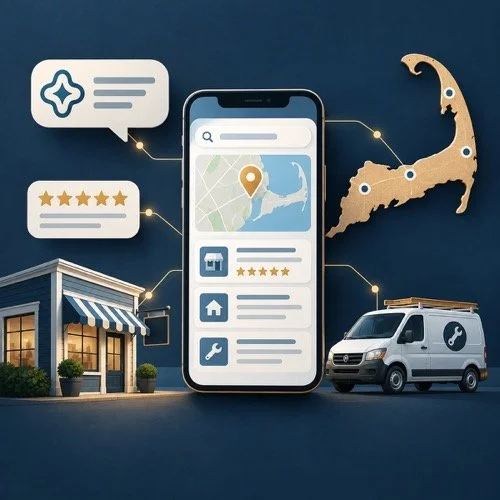
Local SEO helps a Cape Cod business appear when a nearby customer—or someone planning a Cape visit—searches for a service, place or answer connected to a real location. The strongest program combines an accurate Google Business Profile, useful town and service pages, credible reviews, technically accessible content, consistent business information and evidence from relevant local sources. No tactic guarantees a specific ranking or an AI citation.
That definition matters because Cape Cod is not one uniform search market. A year-round resident looking for a plumber in Dennis, a second-home owner planning winter work from another state and a visitor comparing restaurants in Hyannis may all use different language, expect different details and act on different timelines. Good local SEO makes those distinctions clear without turning the website into a pile of nearly identical town pages.
What makes Cape Cod SEO different?
Google says local results are mainly shaped by relevance, distance and prominence. Relevance is how well a business matches the search. Distance is how close the business is to the location Google associates with the search. Prominence reflects how well known and well supported the business appears, including information such as links and reviews.
On Cape Cod, those factors meet a market with unusually strong seasonality. The Cape Cod Commission reported that the region’s summer population rises to well over 400,000 people, not including day visitors. Search demand therefore changes by season, town and audience. A useful SEO plan accounts for that shift while keeping the facts—hours, service availability, booking windows and locations—accurate.
The practical goal is not to “rank for Cape Cod” in the abstract. It is to become a clear, credible match for the searches that can produce the right call, visit, booking, order or qualified inquiry.
The five systems that strengthen local search visibility
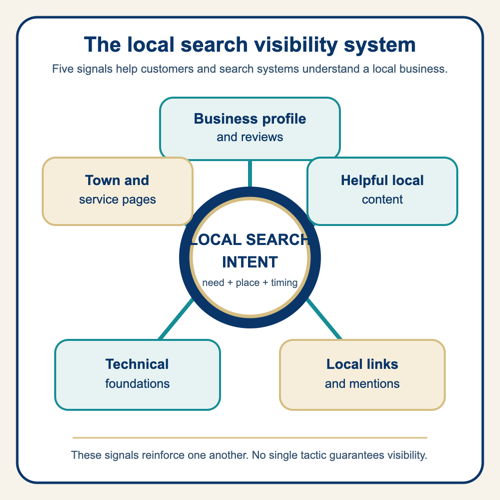
Local visibility is rarely the result of one keyword or one technical adjustment. It comes from several connected systems that help people and search platforms understand what the business does, where it operates and why its information can be trusted.
1. A complete, accurate Google Business Profile
For searches that trigger Google Maps or the local results panel, the Business Profile is often the first—and sometimes only—information a customer sees. Confirm the business name, primary category, address or service area, phone number, website, hours and services. Add real photos that help a customer recognize the location or understand the work. Update holiday and seasonal hours before the customer needs them.
Completeness does not guarantee placement, and businesses cannot pay Google for a better local ranking. It does make the profile more useful and gives Google clearer information to match against relevant searches.
2. Service and location pages built around real customer decisions
A strong service page should explain the problem, the service, who it is for, where it is available, what the process involves, what evidence supports the claim and what the reader should do next. For a business serving several Cape towns, one strong regional page may be enough. Separate town pages make sense only when the content is genuinely different—for example, the service area, permitting considerations, travel logistics, local proof or frequently asked questions change by location.
Avoid doorway pages that simply replace “Barnstable” with “Brewster” or “Falmouth.” They offer little help to the reader and create a weak site experience. Write for the questions a real customer in that market needs answered.
3. Useful local content that adds original knowledge
Google’s current guidance emphasizes helpful, reliable, people-first content and warns against producing generic pages at scale. For a Cape Cod business, useful content might include a seasonal maintenance timeline, an explanation of a local permitting step, a first-hand project lesson, a comparison that clarifies a buying decision or a practical guide tied to a real town or service area.
Use specific evidence: original photos, a documented process, a named expert, a clearly explained calculation, a case example the business has permission to discuss, or links to primary sources. A generic “five tips” article adds little authority if any company in any location could have published it unchanged.
4. Reviews that support both trust and local prominence
Google states that more reviews and positive ratings can help local ranking. Reviews also answer questions that a business cannot credibly answer about itself: Did the team communicate? Was the location easy to find? Did the finished work match expectations? Was the experience worth the price?
Build a consistent, policy-compliant request process after a completed purchase, visit or project. Do not buy reviews, gate requests so only happy customers receive them, or offer incentives that violate platform rules. Respond professionally, correct factual issues when appropriate and use recurring questions as input for future website content.
5. Technical access, structured data and credible mentions
A page cannot help in search if it cannot be crawled, indexed or used comfortably on a phone. Check indexability, page speed, mobile layout, headings, internal links, image filenames and alt text. Make sure contact forms, booking buttons and phone links work at common mobile widths.
Accurate LocalBusiness structured data can help Google understand details such as the business type, location and hours, and may support eligible search features. It is not a ranking shortcut, and the markup must match what visitors can see on the page.
Relevant links and mentions add outside evidence. These may come from a professional association, municipality, respected regional publication, community partner, event organizer or supplier. The objective is not to accumulate directory links. It is to make the business’s real relationships, expertise and local presence easier to verify.
How traditional SEO supports AI-search visibility
For Google’s AI features, the fundamentals of SEO still apply. Google says its generative search experiences use the Search index and core ranking systems to retrieve supporting web pages. A page must be crawlable, indexed and eligible to appear with a Search snippet before it can be considered for those experiences.
That means Cape Cod businesses should focus on the same durable work: accurate entity information, unique expert-led content, clear page structure, current facts, relevant images, internal links and credible external evidence. Google also says there is no special AI schema required and that an llms.txt file does not improve visibility in Google Search. Other AI platforms use their own retrieval and citation systems, so no agency can promise that a business will be named in a particular answer.
For readers and answer systems alike, the most useful format is often simple: answer the main question early, explain the local context, support factual claims, show the process, clarify limitations and make the next step obvious. That is not writing for a robot. It is making the page easier for everyone to understand.
A practical 30-day starting plan
Verify the foundation. Reconcile the business name, phone, address or service area, hours and primary services across the website and Google Business Profile.
Choose one high-value search journey. Start with one service and one realistic market rather than a long list of disconnected keywords.
Improve the destination page. Add a direct answer, service details, local context, proof, FAQs and one clear call to action.
Fix the conversion path. Test the page, form, phone link and confirmation process on desktop and mobile.
Create one original supporting resource. Answer a question the sales or service team hears repeatedly and support it with local expertise or evidence.
Request reviews consistently. Ask eligible customers at a natural point in the relationship and respond to new feedback.
Measure business actions. Track qualified calls, forms, bookings and direction requests alongside Search impressions and clicks.
How to measure whether local SEO is working
Rankings are useful diagnostics, but they are not the final business result. A practical scorecard should connect search visibility to customer action:
Google Search Console impressions and clicks for priority services and locations
Google Business Profile calls, website visits and direction requests
Qualified form submissions, bookings or phone inquiries from organic search
Conversion rate on the service and location pages receiving search traffic
New reviews, review themes and questions customers still cannot answer online
Lead quality, response time and the revenue or pipeline value connected to search
Review the trend by season and market. A Cape Cod business can gain the right visibility even when total traffic falls, particularly if the mix shifts from broad summer browsing to qualified year-round or planning-stage inquiries.
Frequently asked questions about Cape Cod local SEO
Should a business target “Cape Cod” or individual towns?
Usually both, but only where the business genuinely serves the audience. A regional page can explain the overall service area. Town pages should exist when they provide distinct information, proof or logistics—not when the only difference is the town name.
How long does local SEO take?
There is no responsible universal timeline. The starting condition of the site and Business Profile, competition, location, review history, technical issues and publishing pace all matter. Measure early improvements in visibility, profile actions and qualified inquiries, but do not treat a short-term ranking fluctuation as the whole result.
Do reviews improve local rankings?
Google says more reviews and positive ratings can help a business’s local ranking. Reviews also influence customer trust. Ask consistently and ethically, and never treat review generation as a substitute for accurate information or a strong customer experience.
Does a Cape Cod business need special markup for AI search?
Not for Google’s AI features. Google says no special AI markup is required. Standard, accurate structured data can still support traditional search features and help clarify business information, but it does not guarantee an AI citation.
Can a seasonal business pause SEO in the off-season?
It can reduce the frequency of some activities, but the off-season is often the best time to correct technical problems, improve service pages, publish planning content, update photos and build authority before demand rises. Keep hours and availability accurate throughout the year.
Build visibility around the way customers actually search
Sandy Neck Media helps Cape Cod and Plymouth County organizations improve traditional search, local visibility and AI-search readiness without relying on ranking guarantees or novelty tactics. Explore our SEO and AI-search services, review our marketing strategy approach or request a practical search-visibility review.
Sources and further reading
Google Search Central: Optimizing for generative AI features
Google Search Central: Creating helpful, reliable, people-first content
Cape Cod Commission: 2024 Comprehensive Economic Development Strategy
Information and source links reviewed September 28, 2026.