Digital Advertising for Cape Cod Businesses: A Practical Platform Guide
The right advertising platform depends on the job the campaign must do. Google Search and Microsoft Advertising can capture people who are already looking. Meta, TikTok and YouTube can introduce an offer before someone searches. LinkedIn is useful when professional role or employer matters. Nextdoor can support neighborhood-scale reach. Display and remarketing can reconnect with people who already know the business.
That does not mean a Cape Cod business should buy all of them. A better starting point is one measurable customer action, one realistic service area, and the channel whose format matches the way that customer makes a decision.
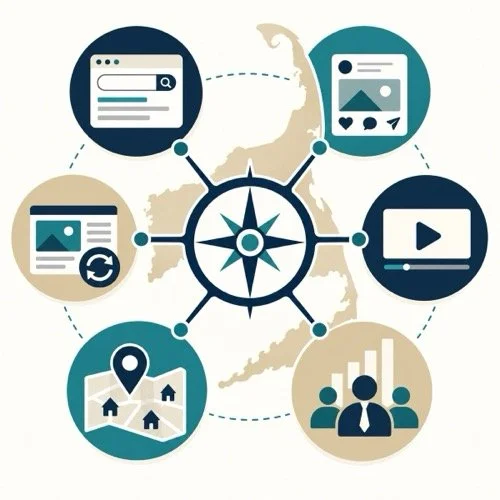
Start with the advertising job, not the platform
Before choosing a channel, finish this sentence: “We need this campaign to help more qualified people ______.” The answer might be call for an appointment, request an estimate, reserve a table, buy a ticket, visit a store, apply for a job or remember the brand before a future purchase.
That action determines the campaign objective, landing page, creative and measurement plan. The platform comes next.
Capture active demand: Search advertising is usually the clearest fit when customers already know what they need and are searching for it.
Create awareness or consideration: Visual social and video channels can introduce a business, event, product or experience before a customer searches.
Reach a professional audience: LinkedIn can make sense when job title, industry, employer or recruiting status is central to the decision.
Reach specific communities: Nextdoor can support neighborhood-level visibility for local services and offers.
Reconnect with prior visitors: Remarketing can keep a business visible during a longer buying cycle, provided the audience is large enough and tracking is configured appropriately.
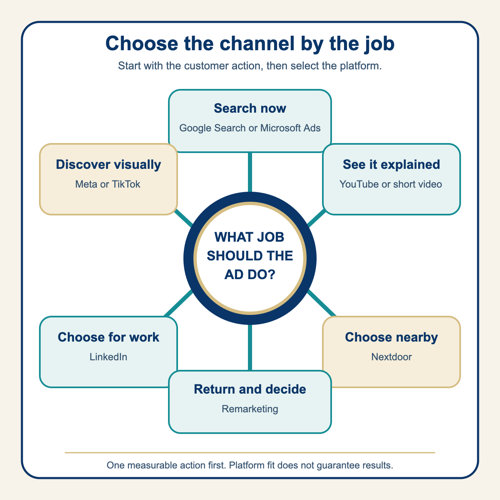
Which advertising platforms fit which Cape Cod businesses?
Google Search: capture existing intent
Search ads appear when a person searches for a relevant product, service or answer. That makes them a practical starting point for businesses whose customers use clear search language: “emergency plumber near me,” “Cape Cod whale watch,” “wedding photographer Cape Cod” or “lunch in Hyannis.”
Search is strongest when the campaign uses tightly related keywords, location settings that reflect the actual service area, useful ad copy and a landing page that answers the searcher’s question. Broad targeting and an unclear destination page can spend money without producing qualified inquiries.
Google also offers local ad formats through Search and Performance Max that can use information from a linked Google Business Profile. Local Services Ads are a separate option for eligible service categories and locations. Screening, verification and badge requirements vary by category and region, so availability should be confirmed before a plan assumes the format can be used.
Good fit signals: customers search with clear intent; the business can answer calls or leads promptly; each service has a relevant landing page; and conversions can be tracked.
Microsoft Advertising: extend paid-search reach
Microsoft Search ads serve across Bing and search partner inventory. The platform can be tested independently or used to extend a paid-search program after the strongest Google campaigns are understood. Microsoft also allows advertisers to import Google campaigns, but imported settings still need review; audiences, search behavior and performance are not identical.
Good fit signals: search already produces qualified leads; the business wants additional search reach; and the team has enough budget and time to evaluate another channel without weakening the primary campaign.
Meta: create visual demand on Facebook and Instagram
Meta advertising reaches people while they use Facebook and Instagram rather than only when they search. It is often better suited to discovery, visual storytelling, events, promotions, lead generation and remarketing than to capturing an urgent search.
The creative has to do real work. A clear restaurant special, home transformation, retail collection, event experience or customer problem can make sense in a feed. A generic stock photo with a broad “learn more” message usually gives people little reason to stop.
Good fit signals: the offer is understandable visually; the business can produce multiple creative variations; the audience definition is meaningful; and the website or native lead form supports the chosen action.
YouTube and Google video: demonstrate, explain and build familiarity
Video can show an experience, answer objections or make a complex service easier to understand. Google’s video campaign options can support awareness, consideration, website traffic, leads or sales, depending on the campaign type and setup.
For a Cape Cod business, video is most useful when the subject benefits from being seen: a property, venue, destination, process, before-and-after result, product demonstration or founder explanation. It is a poor fit when the business cannot sustain useful creative or when the landing experience does not continue the story introduced by the video.
Display and remarketing: maintain visibility during longer decisions
Display ads can reach people across websites, apps and Google-owned properties. For a small local advertiser, their clearest use is often remarketing: following up with people who visited a relevant page, watched a video or otherwise showed prior interest.
That can support services with longer consideration periods, such as remodeling, real estate, private events or professional consulting. It should not be treated as proof that the ads caused every later conversion. Frequency, audience size, privacy requirements and attribution all need attention.
TikTok: earn attention with platform-native short video
TikTok supports awareness, consideration and conversion objectives, and its advertising tools now include search campaigns for supported objectives. The channel is worth testing when the target audience uses the platform and the business can create concise, natural-feeling video rather than simply resizing a static ad.
The deciding factor is not whether the business is “fun.” It is whether the team can repeatedly turn the customer problem, product or experience into useful short-form video and connect that attention to a measurable next step.
LinkedIn: reach professional audiences and job candidates
LinkedIn organizes campaigns around awareness, consideration and conversion objectives, with targeting that can include professional attributes such as job title, seniority, company and industry. That can make it useful for B2B services, specialized consulting, commercial products, partnerships and recruiting.
A consumer business does not automatically belong on LinkedIn simply because business owners use the platform. The audience definition and value of a qualified lead need to justify the cost and narrower professional context.
Nextdoor: support neighborhood-scale visibility
Nextdoor offers business pages, local posts and paid advertising with geographic and audience targeting. It can be considered when proximity and neighborhood trust matter, including home services, pet care, household services and locally relevant offers.
Use it as a testable channel, not as a substitute for reputation. A complete business presence, credible recommendations, clear service boundaries and conversion tracking matter more than an unsupported assumption that “hyperlocal” will automatically convert.
How Cape Cod seasonality changes the media plan
Cape Cod businesses do not all share the same season. A visitor-facing business may need to build awareness before a trip, capture demand during a stay and maintain a smaller year-round program. A home-service company may see weather-driven demand, second-home projects and scheduling windows. A professional service may serve year-round residents, off-Cape organizations or both.
Plan backward from the customer’s decision date, not the date the business wants revenue. A wedding venue may need visibility months before a booking. A same-day service may need search coverage when demand occurs. A seasonal event may need a sequence: early awareness, conversion-focused reminders and a final availability message.
The Cape Cod Commission’s regional economic planning documents the importance of the visitor economy and the region’s seasonal pressures. Those conditions make timing, service-area accuracy and capacity planning part of advertising strategy—not afterthoughts.
Five questions to answer before spending
What action counts as success? Choose a qualified call, completed form, reservation, purchase, store visit or application—not clicks alone.
Is demand already present? If people search for the service, begin by evaluating search. If the offer must be introduced or demonstrated, visual social or video may be more appropriate.
Where and when can the business serve customers? Define towns, ZIP codes, drive times, delivery areas, seasonal dates and capacity before setting geography.
What creative can the team sustain? Search needs relevant copy and landing pages. Social and video need a repeatable supply of strong visuals and messages.
Can the result be measured responsibly? Confirm forms, calls, purchases or bookings can be measured and that any tracking complies with applicable privacy and consent requirements.
Measurement must exist before launch
Platform dashboards can report impressions, clicks and platform-attributed conversions, but a business still needs to connect those signals to real outcomes. Google defines a conversion as a valuable action such as a purchase, sign-up, call or download. The same principle should govern every channel.
Before launch, document:
the primary conversion and any secondary actions;
the landing page and offer for each campaign;
how calls, forms, purchases, reservations or applications will be recorded;
UTM naming and analytics ownership;
the test period and decision threshold;
who will respond to leads and how quickly; and
which numbers will determine whether to continue, change or stop.
Judge the campaign by qualified outcomes and business economics, not by the cheapest click. No platform, targeting method or agency can guarantee a specific return.
A sensible starting mix
Many small businesses should start with one primary channel and one supporting channel—not a thin budget spread across every platform.
Urgent local service: Search may be primary, supported by remarketing or trust-building social content.
Restaurant, retail shop, attraction or event: Meta or video may build demand, while Search captures people planning or looking nearby.
Long-consideration service: Search can capture active research; remarketing and useful video can support the decision over time.
B2B service or recruiting campaign: LinkedIn may be appropriate when professional targeting matters, with Search capturing explicit need.
Neighborhood service: Search can capture need while Nextdoor is tested for community-level reach.
These are starting hypotheses, not universal formulas. The best mix is the one supported by customer behavior, conversion data, seasonality, service capacity and the value of a qualified customer.
Frequently asked questions
Which ad platform is best for a Cape Cod small business?
There is no universal winner. Search is often the clearest fit for active demand. Meta, TikTok and YouTube can create visual awareness and consideration. LinkedIn fits professional audiences. Nextdoor can support neighborhood reach. The right choice depends on the action, audience, geography, creative and measurement plan.
Should a small business advertise on more than one platform?
Only when each platform has a defined job and enough budget to produce useful data. One well-built campaign is generally more informative than several underfunded campaigns with unclear objectives.
How should a seasonal business time its advertising?
Work backward from when customers research, compare and book—not only from the date of the visit or purchase. Use awareness earlier in the decision cycle, then shift messaging and budget toward the actions available as the season approaches.
Are Local Services Ads available to every business?
No. Eligibility, screening and verification vary by service category and location. Confirm current availability and requirements in Google’s Local Services documentation before building a plan around the format.
What should be tracked besides clicks?
Track the actions that create business value: qualified calls, completed forms, reservations, purchases, applications, booked appointments and, when practical, offline outcomes. Also monitor lead quality, response time, cost per qualified outcome and revenue—not just platform-reported activity.
Build the plan around the customer decision
Sandy Neck Media builds digital advertising programs around customer intent, geography, seasonality, creative capacity and measurable outcomes. Our marketing strategy work can also help determine whether paid media is the right next investment at all.
Contact Sandy Neck Media for a practical assessment of which channels fit your business, what must be ready before launch and how results should be evaluated.