Fractional Marketing Team vs. Agency vs. In-House Hire: A Practical Cost and Capability Guide
A fractional marketing team is useful when a business needs ongoing direction and several specialist skills without enough steady work for a full department. An agency can suit a defined campaign or channel. An in-house hire can suit a sustained daily role. The right choice depends on the work, ownership, capacity and total cost—not the label.
It usually starts with an overloaded person. The owner is approving social posts between customer calls. A marketing coordinator is expected to write, design, run ads, fix the website and explain why inquiries slowed down. Or several capable vendors are working from different versions of the plan.
Adding help can solve the problem. Adding the wrong kind of help can leave the same coordination problem with another invoice attached.
For a Cape Cod business, the decision also has a timing dimension: the workload needed to prepare a season may be very different from the workload needed to serve customers during it. Here is how to compare the options on the work you actually need.
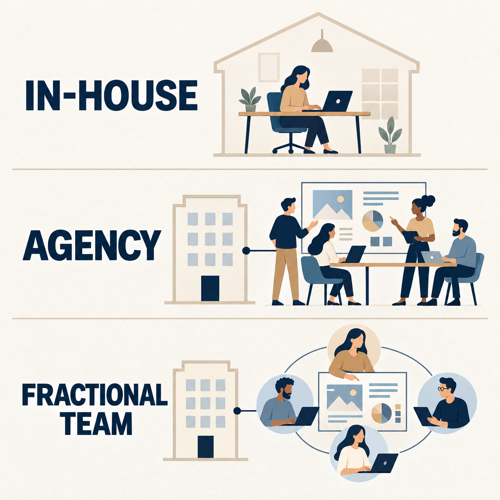
First, define the three models
In-house hire: dedicated capacity inside the business
An employee can develop deep knowledge of your customers, products, colleagues and daily operations. This works well when there is a clear, continuing role and someone can manage it. A retailer that needs daily product updates, store photography and coordination with sales may benefit from an internal marketer who is close to the activity.
The limitation is skill coverage. A capable generalist can coordinate many channels, but that does not make one person a senior strategist, developer, designer, analyst and paid-media specialist. Budget for the specialist work the role cannot reasonably absorb.
Agency: outside expertise for an agreed scope
An agency may manage a website project, a paid-search program, a campaign or a broader marketing relationship. It can be a strong choice when the brief is clear and the business has an internal owner who can set priorities, provide information and make decisions.
Agencies differ considerably. Some provide strategy and integrated execution; others concentrate on a specialty. Ask who will do the work, who makes cross-channel decisions and what coordination is included. An account-management meeting alone does not establish ownership of the whole marketing plan.
Fractional team: shared leadership and execution capacity
A fractional arrangement brings in part of the capacity of a marketing leader and, when included in the scope, the specialists needed to execute the plan. It can help a business that needs several skills each month but does not yet need full-time employees in all those roles.
A fractional CMO and a fractional team are not automatically the same thing. The former may provide leadership only. The latter may also include content, design, search, advertising or website execution. Confirm what is actually included and how much capacity is reserved.
The labels overlap: an agency can deliver a fractional model, and an employee can work alongside either. Compare responsibilities and access to people, not the name on the proposal.
A quick decision guide
Consider an in-house hire when you have steady daily work, a clearly defined role and the time to manage and develop an employee.
Consider an agency when you have a specific project or channel to improve and an internal person who can own the broader plan.
Consider a fractional team when leadership, prioritization and several specialist skills are needed, but a complete internal department would exceed the workload or budget.
Consider a hybrid when an employee knows the business well but needs senior direction or specialist support.
Compare total cost over the same period
A salary and a monthly service fee are different units. Put every option into a 12-month budget and include the work that sits outside the headline price.
For an employee, include salary, employer taxes and benefits, recruiting, equipment, software, onboarding, management time and outside specialists. For an agency or fractional team, include the agreed fee, setup, production, software, out-of-scope work and the internal time needed to support the relationship. Keep advertising spend separate from management fees in every option.
Use salary data as context, not a Cape Cod quote
The U.S. Bureau of Labor Statistics reports national median annual wages of $78,760 for market research analysts and marketing specialists and $166,790 for marketing managers in May 2025. These describe different occupations and responsibility levels. They are not interchangeable job descriptions, Cape Cod salary estimates or total employment costs.
Sources: BLS market research analysts and marketing specialists; BLS marketing managers. Figures checked October 20, 2026.
Benefits are also not simply a percentage to add to salary without checking the denominator. BLS reported that benefits were 30.0% of total private-industry employer compensation in June 2026. That is a broad national aggregate, not a benefits rate for your next marketer. Build your actual employment budget with your payroll adviser. Source: BLS Employer Costs for Employee Compensation.
A transparent worked budget
Here is an illustrative calculation, not a market quote or Sandy Neck price. Suppose your planned hire has a $90,000 salary, $27,000 in employer taxes and benefits, $6,000 in equipment and software, and $18,000 in outside specialist support. Those assumptions produce a first-year budget of $141,000, or $11,750 a month, before recruiting and management time.
A hypothetical outside proposal at $6,000 a month, plus $4,000 setup and $8,000 additional production, totals $84,000 over the same year. That proposal is not automatically the better value: it may buy substantially less time or leave more work with your staff. Compare agreed outputs, reserved capacity, exclusions, ownership and the cost of unfinished work. Paid media is excluded from both examples.
Use the same worksheet with real candidate compensation and written proposals. A smaller fee can be expensive if the business must supply most of the strategy, content and coordination itself.
How Cape Cod seasonality changes the staffing decision
Map the work across a full year before deciding which costs should be fixed. A visitor-facing business may need booking campaigns and website changes before arrivals, quick operational updates during its busiest weeks, then retention and planning work afterward. A year-round professional service may need a much steadier program.
These are planning examples, not a claim that every Cape business shares one season. Mark the dates when offers must be ready, bookings begin, customers need answers and the team has time to approve work. Then ask each provider or candidate how those peaks will be covered.
An outside arrangement is flexible only if the contract and staffing allow it. Ask about notice periods, peak-season availability, minimum scope and what happens when urgent requests arrive. An employee offers continuity, but additional hours and skills still have limits.
Ask who owns the work between meetings
The most useful comparison is often a responsibility map. For each option, name who will:
Set the priorities and decide what gets postponed.
Gather subject-matter knowledge, customer questions and original material.
Write, design, build and quality-check the work.
Approve claims, budgets and publication.
Maintain search visibility, website performance and accurate business information.
Connect inquiries to follow-up and qualified business outcomes.
Explain results and recommend the next change.
This matters for AI tools, too. Automation can assist research, drafting, routing and reporting, but someone must check sources, customer-facing claims and exceptions. Ask what the workflow produces, what receives human review and who fixes an error. Tool access does not replace accountability.
What a useful first 90 days can include
For a business that needs both leadership and execution, a practical starting plan could look like this:
Days 1–30: establish the business goal, audit existing activity, choose a small number of priorities and fix the most consequential tracking or conversion problems.
Days 31–60: improve one priority customer journey—for example, a service page, supporting article, campaign and lead-response process.
Days 61–90: review qualified inquiries, sales feedback and delivery capacity, then adjust the work that should continue.
This is a planning framework, not a promised Sandy Neck deliverable schedule. Agree on the outputs, dependencies, approval deadlines and measurement before work starts. For a broader planning framework, see our 90-day marketing plan for a Cape Cod business.
Questions to ask before you sign
Who is my day-to-day lead, and who performs each specialist task?
Does the fee include strategy and execution, or just advice?
What capacity and deliverables are reserved for us each month?
Which expenses, revisions and urgent requests cost extra?
Who owns our accounts, content, data and website access?
How will you work with our existing employees and vendors?
What must we supply, and how quickly must we approve work?
How will we assess lead quality and business results?
What happens if scope changes or the engagement ends?
Frequently asked questions
Is a fractional marketing team always cheaper than hiring?
No. Cost depends on seniority, scope, hours, specialist work and what the business still supplies internally. Compare total annual cost for comparable responsibilities. A broad outside engagement can cost more than one junior hire while providing different capabilities.
Can a fractional team support an existing marketer?
Yes, when responsibilities are clear. An internal employee can own day-to-day knowledge and coordination while an outside team supplies leadership or specific skills. Avoid giving two people conflicting authority over the same priorities.
Should I hire a fractional CMO or a full team?
Choose leadership support when execution capacity already exists and the main gap is direction. Consider a team when the plan also needs people to write, design, build or run campaigns. Confirm the scope rather than assuming the title includes execution.
Choose the setup your business can actually use
The strongest arrangement gives you enough capability, a clear owner and a workload your organization can sustain. That could be an employee, an agency, a fractional team or a combination.
Sandy Neck Media's fractional marketing service brings direction and channel support together around business priorities. If you are comparing options, talk with us about your current team, the work that needs doing and the gaps you want to close. We can discuss an appropriate scope rather than assuming every business needs the same staffing model.